


Sponsored ads, or Google Ads as they are more commonly known, are now widely used by businesses to generate leads and drive purchases. I am often asked whether a company should invest in them. As with most things, the answer is, “It depends.”
Lets look at a typical search to dig into this.
When I start an SEO project with clients invariably this is what we see in the Search Engine Results Pages (aka SERPS) for a service or offering. This is a search for plumbers in Cork.

In the highlighted red box, you can see the “Sponsored” title. This indicates that these plumbers are running paid advertisements to attract clicks. In this instance, four sponsored results dominate the top of the page (above the fold) on desktop.
Here are some important observations, which go beyond the technical aspects or the intricacies of online advertising:
- From my experience, a significant number of people don’t even notice the “Sponsored” label. While I am attuned to this because of my work in this space, a large percentage of the population is not familiar with Google Ads at all.
- We often assume that the top results are the best options. Personally, I would argue that these results simply reflect those who are most skilled at running ads.
- Even if someone recognises that these are advertisements, they might still click on them. For instance, if you have an urgent issue, such as a leak, and need a plumber, you are unlikely to spend time conducting an extensive online research project.
- These ads are targeted for my area (in this case CorK0.
Running Ads Yourself
Google makes it tantalisingly easy to get started with Google Ads—it’s one of their major revenue streams, after all.
However, the reality is that Google Ads is a complex platform with many moving parts. In fact, you can even take a Google Ads Certification course to learn how to navigate these intricacies. To add to the challenge, the platform is continually evolving, with new features and updates regularly changing how the overall tool functions.
From experience, I can confidently say that people who don’t understand the intricacies of Google Ads – how to run them effectively from start to finish, track success, set goals, and develop optimised landing pages – often end up wasting a lot of money. This is why I frequently hear statements like, “We tried Ads, but it was a waste of time.”
In many cases, businesses work with PPC agencies that focus solely on running the ads – neglecting critical aspects such as destination pages, tracking, and measurement. This often leaves clients in a difficult position, unsure whether the ads are actually delivering results.
By this, I mean that directing well-structured ads to a website that isn’t designed to convert is, once again, wasting your valuable budget. We’ve all experienced landing on poorly structured sites, failing to find what we’re looking for (which is often something as simple as a phone number), and then leaving in frustration.
So my advice is don’t run ads yourself get a professional to help you and run them for you with your input.
ROI Formula for PPC
Return on Investment (ROI) for Pay-Per-Click (PPC) campaigns is measured by comparing the revenue generated from the campaign to the cost incurred. The goal is to determine how effectively your PPC spend translates into profits. Here’s a step-by-step breakdown:
The formula to calculate ROI is below

Steps to Measure ROI
- Track Revenue from PPC
Use analytics tools to determine the revenue directly attributable to your PPC campaigns. This is often done by tracking conversions (e.g., purchases, leads) through conversion tracking tools like Google Ads or Google Analytics. - Determine Total PPC Costs
Include all costs related to the campaign:- Google Ads spend
- PPC Agency fees (if applicable)
- Other associated costs (e.g., landing page optimisation)
- Calculate ROI
Subtract the total PPC costs from the revenue generated by the campaign. Divide this figure by the total PPC cost and multiply by 100 to get the percentage ROI.
Example
- Revenue from PPC: €5,000
- Cost of PPC Campaign: €1,000
- PPC Agency Fees: €350
- Total PPC Costs: €1,350
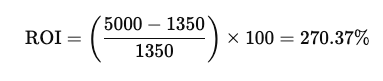
This means the campaign generated a 270.37% return on investment.
Important Notes
- ROI is typically expressed as a percentage to help compare campaign effectiveness.
- For campaigns focused on lead generation rather than direct sales, you might calculate ROI based on the value of each lead or projected lifetime value of customers.
- Tools like Google Ads’ built-in ROI calculator or platforms such as HubSpot can help automate this process.